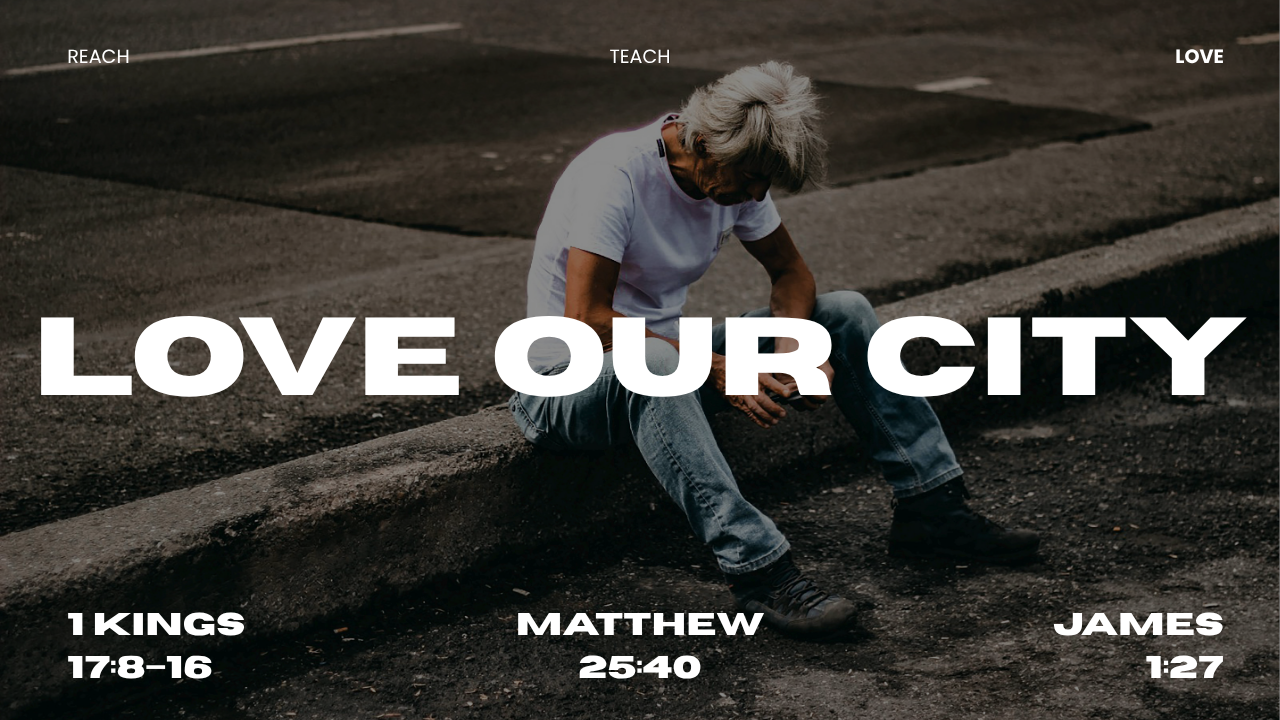
LOVE OUR CITY
Go to the Broken
DAY 1 — GOD SEES THE BROKEN
Scripture: 1 Kings 17:8–10
Elijah had been sent into hiding during a devastating drought, but then God told him to go to Zarephath in Sidon. There, Elijah would encounter a widow gathering sticks. She was not looking for a miracle. She was preparing what she believed would be her final meal for herself and her son.
Before Elijah ever saw this woman, God already knew her story. He knew her hunger. He knew her fear. He knew what she had left and what she had lost. God saw her before anyone else did.
That is one of the first things we need to recover when we talk about loving our city: we have to learn to see people the way God sees them. It is easy to see homelessness, poverty, addiction, loneliness, broken families, or people who are struggling and reduce them to their circumstances. But God doesn’t see a category. He sees a person made in His image.
There are people we pass every day whose stories we know nothing about. We don’t know what they carried into the morning or what they are afraid will happen tomorrow. We don’t know how many times they have been disappointed or how long they have been praying for help. But God knows.
And sometimes before God asks us to do anything, He asks us to notice.
Reflection:
Who are the people you have become accustomed to overlooking? Ask God to give you His eyes to see the people around you—not simply their circumstances, but their dignity, their story, and their need.
Prayer:
Jesus, give me eyes to see what You see. Forgive me for the times I have become numb to the brokenness around me. Help me recognize the people You are already seeing and loving. Give me compassion that moves beyond observation into action. Amen.
Action Step:
Pay attention today. Look for one person you might normally overlook. Make eye contact, learn their name, start a conversation, or find a practical way to acknowledge their dignity.
DAY 2 — MOVE TOWARD THE NEED
Scripture: 1 Kings 17:9
God didn’t simply tell Elijah to care about the widow. He told him to go to her.
There is a difference between caring about brokenness and moving toward broken people. We can feel compassion from a distance and still remain unchanged. We can pray for our city without ever allowing our prayers to interrupt our lives. But throughout the ministry of Jesus, we see Him moving toward people. He went toward the sick, the grieving, the poor, the rejected, the outsider, and the sinner.
The gospel itself is a story of God moving toward us. Jesus did not love humanity from a safe distance. He came into our world, took on flesh, entered our suffering, and gave Himself for us.
If we are going to follow a God who moves toward us, we have to become people who are willing to move toward others.
That may require leaving comfort. It may require giving up time. It may mean listening when you would rather keep moving. It may mean serving someone whose circumstances are complicated. It may mean entering a relationship where you don’t have an easy solution.
You don’t have to fix someone’s entire life. You don’t have to carry every burden in your city. But when God puts someone in front of you, you can ask what faithfulness looks like in that moment.
Reflection:
Where have you been keeping your distance from people who are hurting? What would it look like to move one step closer?
Prayer:
Lord, don’t let me become comfortable with staying at a distance from the people You have called me to love. Give me courage to move toward need with humility and compassion. Show me where You are sending me and help me obey. Amen.
Action Step:
Do one thing today that requires you to move toward someone rather than simply think about their need. Reach out, check in, serve, listen, or pray with someone.
DAY 3 — GIVE WHAT YOU HAVE
Scripture: 1 Kings 17:11–13
The widow didn’t have much. In fact, she told Elijah that she was preparing the last meal for herself and her son. Yet Elijah asked her to trust God with what she had.
Her story challenges one of the excuses we often make when it comes to serving others: “I don’t have enough.”
We may think we need more money, more time, more knowledge, more influence, or more resources before we can make a difference. But God has never required us to begin with everything. He asks us to surrender what we already have.
The widow had flour and oil. Elijah had a word from God and a willingness to obey. Neither appeared to have enough for what was in front of them. Yet God used what they surrendered.
You don’t have to have everything to be useful to God. You have to be willing to place what you have in His hands.
Your time can become ministry. Your home can become ministry. Your resources can become ministry. Your ability to listen can become ministry. Your willingness to pray can become ministry. What feels ordinary in your hands can become significant when surrendered to God.
The Kingdom is often built through small acts of obedience that nobody sees.
Reflection:
What have you been telling yourself you don’t have enough of? How might God be asking you to surrender what you already have?
Prayer:
Father, I give You what I have. I may not have everything I wish I had, but I trust that You can use what I surrender. Teach me to stop waiting until I have more and start being faithful with what is already in my hands. Amen.
Action Step:
Give something away today—your time, attention, money, food, encouragement, or practical help—to someone who could use it.
DAY 4 — BECOME PART OF THE ANSWER
Scripture: James 1:27
James tells us that pure and undefiled religion includes caring for those who are experiencing affliction. He is reminding the church that faith cannot remain disconnected from the lives of hurting people.
This is where discipleship becomes real.
It is easy to pray, “God, help them.” Sometimes God answers that prayer by asking, “Will you help them?” It is easy to pray for provision while never asking whether God wants to provide through us. It is easy to ask God to renew our city while keeping our lives untouched by the brokenness around us.
But God often works through His people.
Elijah became part of God’s provision for the widow. He didn’t create the miracle. God did. But Elijah’s obedience placed him in the middle of what God was doing.
We don’t serve people because we can fix them. We serve because we can participate in what God is already doing.
This is an important distinction. We are not saviors. Jesus is. We cannot carry the weight of every person’s situation. But we can be faithful with the opportunities God gives us. We can become available. We can offer compassion. We can bring practical help. We can pray. We can listen. We can show people that the love of Jesus is not merely something we talk about on Sunday.
Reflection:
Is there a situation you have been praying about where God may be inviting you to become part of the answer?
Prayer:
Jesus, make me available. Where I have prayed for someone else to act, show me whether You are asking me to participate. Give me wisdom to know what is mine to carry and courage to carry what You have entrusted to me. Amen.
Action Step:
Identify one specific need you have been praying about. Ask God what your next faithful step should be, then take that step.
DAY 5 — GO AND LOVE YOUR CITY
Scripture: Matthew 25:35–40; Philippians 3:20
Jesus teaches that when we care for the hungry, the thirsty, the stranger, the sick, and the vulnerable, we are serving Him. That should radically change how we see the people around us.
The person in need is not merely someone we are helping. They are someone Jesus loves.
This is at the heart of what it means for us as Legacy to Reach The Lost, Teach God’s Word, and Love Our City. Loving our city is not about pretending everything is good. It is not about compromising truth. It is about entering our city with the heart of Jesus and becoming a tangible expression of His grace and truth.
We are called to be a people who notice what others overlook and move toward what others avoid. We are called to carry the presence of Jesus beyond the walls of the church and into the ordinary places where people live, work, struggle, and hope.
Our vision is For The Renewal Of All Things. That means we cannot limit renewal to what happens in a Sunday service. We pray for renewal in our city, but we also make ourselves available to participate in it. Sometimes renewal looks like someone encountering Jesus in worship. Sometimes it looks like someone receiving a meal. Sometimes it looks like a conversation, a prayer, a care kit, a generous gift, or a person finally realizing that somebody sees them.
The city doesn’t simply need churches that gather. It needs people who will go.
So this week, don’t simply ask God to show you what is broken. Ask Him what He wants you to do about it. Don’t simply pray for the hurting. Become willing to move toward them. Don’t wait until you have everything. Give what you have. And don’t underestimate the ordinary things God can use when they are surrendered to Him.
Reflection:
What would it look like for you to intentionally love your city this week? Who is God placing in front of you, and what is one practical way you can serve them?
Prayer:
Jesus, send me. Give me Your heart for my city and Your compassion for the people around me. Make me willing to go beyond comfort and convenience. Teach me to serve without needing recognition and to love without expecting anything in return. Let my life become an expression of Your presence, Your truth, and Your mercy. Use Legacy to bring renewal wherever You send us. Amen.
Action Step:
Choose one concrete way to serve someone in your city this week. Don’t wait for the perfect opportunity. Start with the person and the need God has already placed in front of you.